I run a popular Pinterest page for Medieval Dragons. I try to keep it updated with whatever I find during my almost daily searches. One thing I have noticed is that there are a few creatures that are close to dragons but are not. Call me picky but if I am going to classify something as a dragon, then it had better be a dragon. The other creatures that appear similar to dragons are asps, serpents, and a few others depending on how the scribe drew them such as cockatrice, basilisk and griffins. I am concerned today with asps since they appear to be the closest in design to that of dragons.
Which one is a dragon?


The dragon is the one that is in the shield. The other two look like dragons but they are asps. How then do you determine what is a dragon and what is an asp?
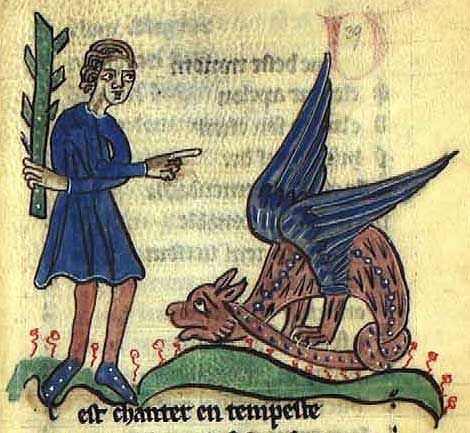
To quote directly from Medieval Bestiary: “The asp is a serpent that avoids the enchantment of music by pressing one ear against the ground and plugging the other ear with its tail. In some versions the asp guards a tree that drips balm; to get the balm men must first put the asp to sleep by playing or singing to it. Another version holds that the asp has a precious stone called a carbuncle in its head, and the enchanter must say certain words to the asp to obtain the stone.” It can also be known as a Prester…something I have seen before during my readings of medieval scrolls.
I have also read that Asps plug their ears in order to avoid hearing bible verses being read to it.
Here is another Asp…just to make sure you got it:
Sources used:
Medieval Bestiary – http://bestiary.ca/beasts/beast268.htm
Asp3 – http://www.kb.dk/permalink/2006/manus/225/eng/39/
Asp1 and Asp2 came from Pinterest and I cannot currently reference their source
 Sir Seved Ribbing, SCA
One thought on “Is that an Asp or a Dragon?”